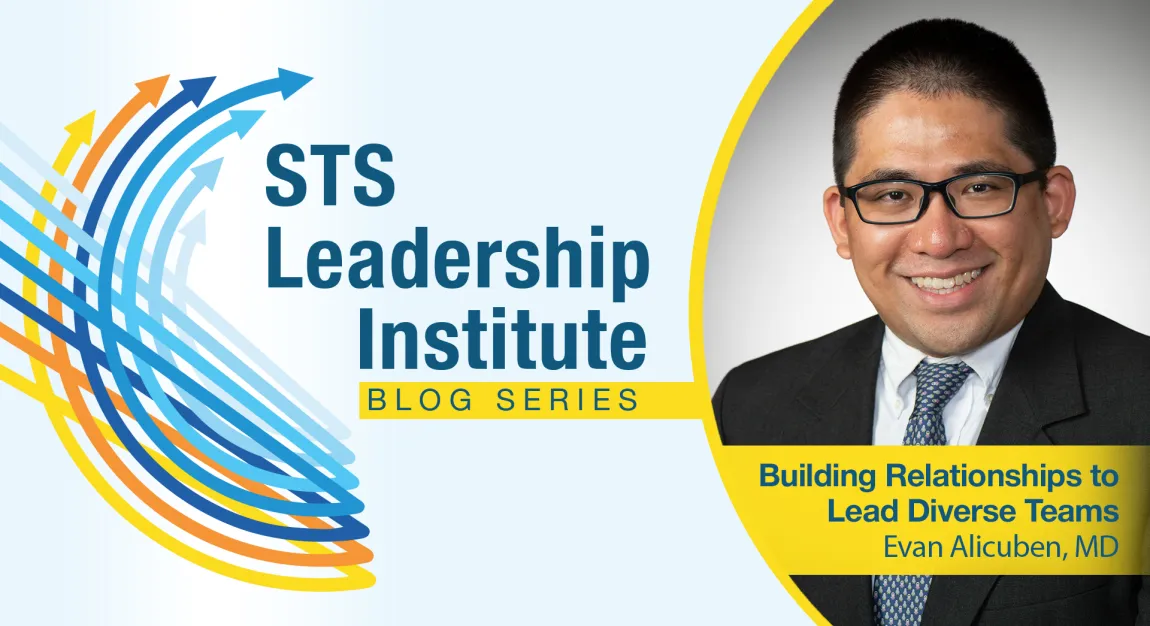
- The STS Leadership Institute fosters meaningful connections that strengthen leadership growth.
- Effective leadership requires intentional action in challenging moments.
- Leadership development is about applying lessons from the past to create a better future.
Entering into the STS Leadership Institute, I had two main goals:
- Build relationships with other surgeons that share common leadership interests.
- Hone a broad skill set that can be used in future leadership positions.
Following the recent session of the institute held in Chicago, I came to realize how well within reach these goals are thanks to the incredible organization of the day and the insightful moderators and speakers in attendance.
While the entire day was engaging and educational, I was particularly impressed and inspired by the session on Leading Diverse Teams and Implicit Bias, moderated by Dr. Minerva Romero Arenas. Based on the title of the session, I was eager to develop skills to address these complex issues that I will surely encounter in the future. After a brief introduction, each table was assigned a specific case study highlighting a challenging scenario. Our group’s task was to discuss how this should be handled, considering various challenges to each stakeholder. Having already been engaged in thought-provoking conversations with new colleagues, I was eager to hear their perspectives.
We were given a scenario where an OR staff member made an inappropriate joke while not realizing it was directed at a team member. As I reflected on the situation, I quickly recalled not just one but multiple instances of having already lived through this. How had I responded in that moment? We had extensive discussions at our table, expertly moderated by Dr. Melanie Edwards, about not assuming intent, actively neutralizing the situation, and directly addressing the offender as well as those the comment offended.
As the session went on, I thought about the times when I had been faced with similar situations. One thing was clear: I could have done so much more. I could have advocated more aggressively, been more intentional with my actions, and been more effective in leading towards a better conclusion for the team. With these new perspectives, I resolved to do better.
Following our individual group conversations, we had a large group discussion in which each table shared its findings. Having learned so much from our small group, I was anxious to hear what others had encountered and worked through. What quickly became clear to me was that I was repeatedly hearing familiar situations.
While I had anticipated that preparations for future encounters would happen in this session, I had not expected a very much-needed reminder of how often these scenarios already happen. In many ways, we were learning how best to deal with the future’s past. Getting to absorb so many viewpoints from colleagues at a similar career stage was not only incredibly educational and eye-opening but also a call to action for all of us to be the change needed. Only by purposefully leading will we bring success to a diverse team.
On the way to the airport, I reflected on the day’s activities and the concepts we discussed and practiced. There is no doubt that the experience gained through the STS Leadership Institute was already changing my abilities for the better, and I look forward to continuing on this journey with new colleagues who have quickly become friends.
Dr. Alicuben is an Assistant Professor of Cardiothoracic Surgery and Director of Thoracic Surgery Clinical Research and Quality and Outcomes at the University of Pittsburgh. His research focuses on clinical outcomes for benign and malignant foregut disorders, large database research, and surgical education.