Image
STS News Banner

Top News Story: A Special CNN Report 

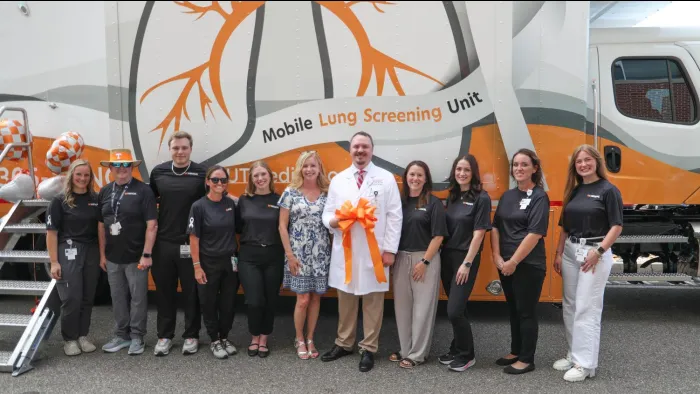
In a new CNN article, Dr. Jessica Donington, STS second vice president, and Dr. Chi-Fu Jeffrey Yang help debunk seven common misconceptions about lung cancer, highlighting the lifesaving impact of early detection and surgical care. STS continues to advocate for expanded screening access and updated eligibility criteria so more patients can be diagnosed earlier. Read the article

Science Spotlight

Mara Antonoff, MD, and Jessica Donington, MD, MSCR, on how STS is advancing evidence in lung cancer care.

Ram Kumar Subramanyan, MD, PhD, Chair, STS Council on Quality and Research, Highlights Updates to The Society's Research and Analytic Center

Surgeon Spotlight

Life as a Surgeon and a Parent

Caption

Mentorship and the Future of Cardiothoracic Surgery 

Latest News and Insights
Image
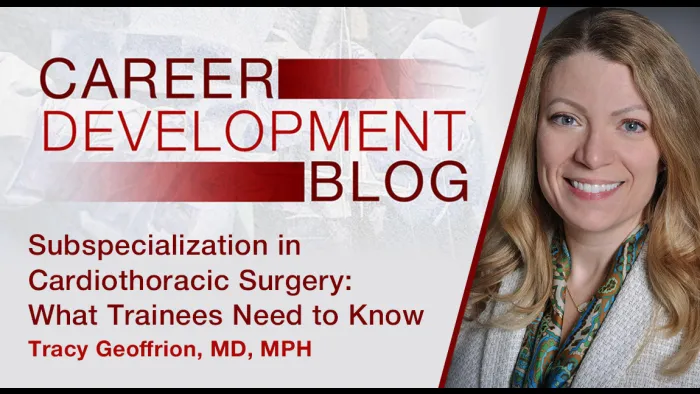
Career Development blog by Dr. Olugbenga Okusanya


Though we are taught many skills during cardiothoracic surgery training, some of the most important are learned only after entering practice. One of those skills is the art of onboarding a new partner.

4 min read
Olugbenga Okusanya, MD

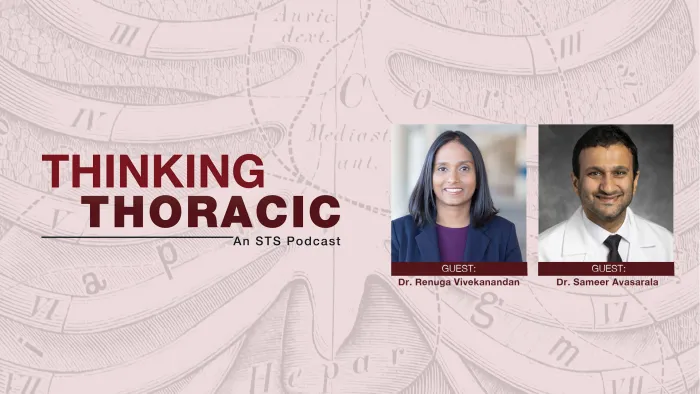
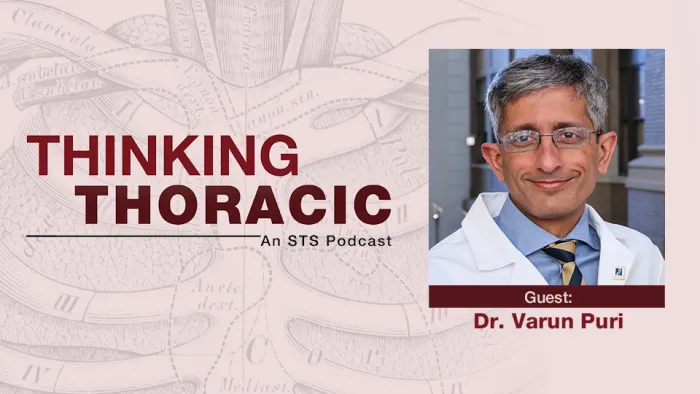
In recognition of National Women’s Health Month, this episode of Thinking Thoracic analyzes the evolving landscape of female-specific lung cancer care. Co-hosts Dr. Erin Gillaspie and Dr. Jane Yanagawa sit down with guest Dr. Leah Backhus to discuss a critical disparity: lung cancer is the leading cause of cancer death among women, yet screening practices remain inequitable. 

40 min

Surgeons and multidisciplinary teams from across the country gathered May 14–15 in Norcross, Georgia, for the 2026 STS Workshop on Robotic Cardiac Surgery. This intensive, two-day program combined expert lectures, case discussions, and immersive simulation to help teams launch or advance their robotic cardiac surgery programs.

Designed for all experience levels, the course focused heavily on robotic mitral valve procedures and coronary revascularization.

High-Fidelity Simulation Builds Team Confidence

Image
Dr. Arghami and Dr. Geirsson
Course directors Dr. Arman Arghami and Dr. Arnar Geirsson 

Participants spent significant time in a state-of-the-art simulation facility, gaining hands-on experience with surgical robotic platforms. Lab sessions covered critical techniques including:

  • Robotic mitral valve repair and replacement
  • Total endoscopic coronary artery bypass (TECAB)
  • Hybrid coronary revascularization

Under expert faculty guidance, attendees practiced port placement, myocardial protection, and intraoperative troubleshooting. The environment allowed surgeons, bedside assistants, and OR staff to refine their real-time coordination.

“STS has been committed to robotic cardiac surgery for the last several years, which has been instrumental as we continue to advance the robotic cardiac surgery subspecialty through both this workshop and its integration into the Annual Meeting,” said course co-director Arnar Geirsson, MD, of NewYork-Presbyterian/Columbia University Irving Medical Center.

A Comprehensive Valve and Coronary Curriculum

Structured didactic sessions reviewed the latest evidence, patient selection criteria, and operative strategies. Faculty experts covered:

  • Mitral & Tricuspid Pathways: Resection-based repair, complex pathologies (endocarditis, annular calcification), and concomitant Maze procedures
  • Coronary & Aortic Pathways: LITA/BITA harvesting, robotic MIDCAB, and aortic valve replacement
  • Advanced Techniques: Multivalve procedures, combined valve/CABG cases, and managing complications

Focus on Program Infrastructure

Image
2026 STS Workshop on Robotic Cardiac Surgery

Beyond technical mastery, the workshop emphasized the business and logistics of robotics. Sessions explored how to optimize OR setup, streamline interdisciplinary communication, and secure institutional support to build a sustainable service line.

“During this year’s workshop, the focus on teams helped bring together the interests of the faculty and allied health professionals, including surgical assistants and scrub teams, so they could learn together and build teams that advance their practice,” said course co-director Arman Arghami, MD, of Mayo Clinic.

Through its powerful mix of high-tech simulation and collaborative learning, the STS Workshop remains a premier launchpad for the future of minimally invasive cardiac surgery.

May 19, 2026
2 min read
Image
Rep. Eric Burlison SSM Health site visit in St. Louis

On May 6, 2026, Representative Eric Burlison (R-MO) visited SSM Health Saint Louis University Hospital to learn how policy decisions impact surgeons—and the patients they serve. When lawmakers visit a hospital, advocacy becomes tangible. That was the case when Rep. Burlison toured SSM Health Saint Louis University Hospital alongside cardiothoracic surgeons Dr. Jen Vigneswaran, Dr.

3 min read
By Haley Howell, STS Advocacy

Determining the optimal management strategy for pleural mesothelioma (PM) remains one of the most challenging areas in thoracic oncology. As a rare and aggressive malignancy, PM requires careful coordination of diagnostic, surgical, and systemic therapies. While surgery has historically played a central role, its benefit continues to be debated.

The Society of Thoracic Surgeons (STS) 2026 Expert Consensus on the Multimodal Treatment of Pleural Mesothelioma, developed by a multidisciplinary panel and published in The Annals of Thoracic Surgery, provides updated recommendations on the multimodal management of PM, with particular emphasis on the role of surgical intervention.

Bridging Evidence and Real-World Practice

Image
Dr. Jeffrey Velotta
Dr. Jeffrey Velotta

A key challenge addressed in the document is the gap between clinical evidence and real-world outcomes. According to lead author Jeffrey Velotta, MD, of Kaiser Permanente Oakland Medical Center, that gap is often driven by differences in surgical experience. “The biggest divide is between general thoracic surgeons and those with high-volume mesothelioma experience,” Velotta said, noting that outcomes are closely tied to disease-specific expertise and case volume. He emphasized that many studies and guidelines do not fully account for this variability. “Mesothelioma-specific experience—not just general surgical skill—can significantly impact outcomes,” he added.

Refining Diagnosis and Staging

A central theme of the recommendations is the importance of accurate diagnosis and staging. The panel strongly emphasizes that adequate pleural biopsy is essential for confirming histologic subtype, which directly influences prognosis and treatment decisions.

In addition, the consensus highlights the critical role of advanced imaging:

  • CT and PET imaging: Required at a minimum to assess disease extent.
  • Multidisciplinary Tumor Board (MTB): Essential for treatment planning, involving surgeons, oncologists, radiologists, and pathologists with specific PM expertise.

Multimodal Therapy as the Standard Approach

The consensus emphasizes that PM treatment should integrate surgery with systemic therapies such as chemotherapy, immunotherapy, or radiation. When evaluating surgical candidates, the panel suggests focusing on several key clinical indicators:

  • Histologic subtype: Greatest benefit is seen in epithelioid, localized disease; outcomes remain poorer for sarcomatoid and biphasic subtypes.
  • Performance status: A patient's overall functional ability is an independent prognostic indicator.
  • Physiologic reserve: Careful assessment of cardiopulmonary function and nutritional levels.
  • Case volume: Surgery should be concentrated in high-volume centers with documented experience in PM management.

“Patients benefit most from a multimodal approach that combines surgery with systemic therapy,” Velotta said.

Surgical Approach: Moving Toward Lung-Sparing Techniques

One of the most definitive recommendations is the strong preference for lung-sparing surgical techniques. Pleurectomy/decortication (P/D) and extended P/D (EPD) are favored over extrapleural pneumonectomy (EPP), which carries higher morbidity without a clear survival advantage in contemporary studies. “Lung-sparing surgery, when performed in experienced centers, can offer meaningful long-term benefits with acceptable risk,” Velotta noted.

Treatment Sequencing and Ongoing Uncertainty

Therapy sequencing remains an area of active debate, with both neoadjuvant and adjuvant approaches considered reasonable. Velotta highlighted two key unanswered questions: “We still don’t know whether chemotherapy is best given before or after surgery, and whether intraoperative adjuncts should be used routinely.”

Recent data, including the MARS-2 trial, have also questioned the overall benefit of surgery, though the panel emphasizes ongoing controversy related to trial design and differences in surgical expertise.

A Framework for Complex Decision-Making

As treatment strategies for pleural mesothelioma continue to evolve, the STS consensus provides a structured yet flexible framework for clinicians. While acknowledging gaps in high-quality evidence, the panel emphasizes the importance of expertise, multidisciplinary care, and individualized treatment planning which includes surgery in a multimodal regimen to optimize patient outcomes.

Read the Annals article.

May 15, 2026
3 min read

In this episode of Same Surgeon, Different Light, Dr. Cherie Erkmen and Dr. Sara Pereira sit down with Dr. Ara Vaporciyan, professor of thoracic and cardiovascular surgery at the University of Texas MD Anderson Cancer Center, to explore a career dedicated to advancing surgical education and leadership.

60 min

In a new episode of The Resilient Surgeon, host Melanie Edwards, MD, sits down with cognitive neuroscientist Daniel Smilek of the University of Waterloo’s Vision & Attention Lab to explore how attention and perception shape performance. Their conversation dives into the realities of everyday multitasking, examining how it contributes to lapses in attention, cognitive errors, and mind wandering. Smilek connects this research directly to surgical practice and surgeon well-being. Listen today.

50 mins.

On April 24, 2026, the STS Leadership Institute convened in Chicago for its second session in a five-part leadership development series. Held at the Fairmont Chicago, the one-day program brought together more than 40 participants, six task force surgeons, and five faculty members to explore team dynamics, personal growth, and leadership effectiveness. The event began with a welcome reception the evening prior, fostering early connections among attendees.

The Leading Others session focused on core leadership competencies, including leading diverse teams, managing conflict, evaluating performance, and cultivating a culture of wellness—skills essential for cardiothoracic surgeons navigating increasingly complex clinical and organizational environments.

Interactive Learning and Practical Leadership Strategies

The program opened with remarks from STS President Vinay Badhwar, MD, and course director Mara B. Antonoff, MD, who emphasized the importance of continuous leadership development. Early sessions, led by Dr. Antonoff and Ram Kumar Subramanyan, MD, PhD, examined how individual growth strengthens team leadership.

Attendees engaged in interactive case scenarios and small-group discussions, with a focus on evaluating early-career colleagues—an increasingly important skill as participants step into leadership roles. “Programs like this reinforce that leadership is a skill we have to continually refine,” said Leadership Institute participant Evan Alicuben, MD. “The combination of self-reflection and practical application made it relevant to how we lead our teams every day.”

Afternoon sessions continued with case-based discussions on conflict management, drawing on the “Five Dysfunctions of a Team” framework. Participants worked in table groups to analyze interpersonal dynamics and develop actionable strategies. “The case-based format and small-group discussions really brought the concepts to life,” said Leadership Institute participant Kyla Joubert, MD. “We were able to work through real scenarios and leave with strategies we can apply right away in our own institutions.” A session on fostering a culture of wellness, led by Melanie A. Edwards, MD, reinforced the role of leadership in supporting team well-being and resilience.

Throughout the day, the emphasis on case scenarios and small-group dialogue created an engaging environment for exchanging perspectives and applying concepts in practice.

Looking ahead, the STS Leadership Institute will continue its curriculum with additional sessions leading to a capstone at the 2027 STS Annual Meeting in San Diego, creating an ongoing development experience to help participants lead effectively in a rapidly evolving healthcare landscape.

May 4, 2026
2 min read

In this episode, Dr. Cherie Erkmen and Dr. Sara Pereira sit down with Dr. Kazuhiro Yasufuku of the University of Toronto, a global leader in minimally invasive thoracic oncology, to explore a career shaped by discipline, innovation, and cross-cultural experience.

49 min

Browse News By Topic

Dr. Sharon Ben-Or and her surgical team.

Member News

Learn about member experiences from your specialty, and stories about the ever-evolving landscape of cardiothoracic surgery.

View >

A view of a laboratory.

Technology

Learn about science, technology, and date-driven tools made possible by the STS National Database.

View >


Dr. Ourania Preventza with mentees.

Advocacy

Learn about Leadership, Advocacy, and Regulatory Action; you and your colleagues are taking steps to drive change in healthcare institutions and on Capitol Hill.

View >


The STS Blog

From career advice to expert perspectives illuminating the latest findings in the media, STS authors share their insights and experience.

View Blogs


Press Releases

News and announcements for cardiothoracic surgery, the health care press, and the public.

View Press Releases


STS News

The Society’s quarterly magazine brings you the latest CT surgery news, research, advocacy updates, surgeon stories, and more.

STS 2026 Preview    Summer 2025     Spring 2025     Winter 2025   


For Media Representatives

All media inquiries, including requests for interviews with leading experts in cardiothoracic surgery.

Learn more


Share Your News and Stories 

STS wants to hear from its members and share their news and stories with others. Working on new research or an innovative initiative? Making an exciting career move? Receiving a promotion? Honored with an industry award?  Send us an email at stsnews@sts.org.