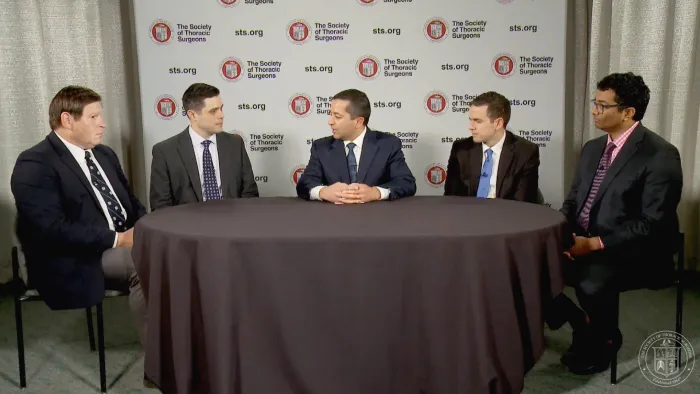
More cardiothoracic surgery programs are incorporating robotics training for residents and fellows. But should robotics be a standard part of the curriculum and have a presence on the in-training and board exams? Dr. Rishinda M. Reddy, from the University of Michigan, moderates a discussion with colleagues about the principles of robotics training, how they obtained funding for their robotics programs, and the importance having expanded minimally invasive skills. This video also features Natalie S. Lui, MD (Stanford University, T.

Vinay Badhwar, MD asks seasoned and early career colleagues for tips on making a good impression during an interview, making sure that the job is a great fit, how to find the best career resources, and how to engage and maintain good mentors.
22 min.

Endocarditis is one of the most challenging infections to treat for cardiothoracic surgeons, and the opioid epidemic has led to a staggering increase in the number of infective endocarditis cases seen in the United States. Dr. Robbin G. Cohen talks with some of the world’s leading experts in treating valve disease and endocarditis—Drs. Joseph E. Bavaria, Eric E.

Robbin G. Cohen talks with some of the world’s leading experts in treating valve disease and endocarditis—Drs. Joseph E. Bavaria, Eric E. Roselli, and Scott Goldman—about when surgeons should get involved in the treatment process, when and how long to treat with antibiotics, the best candidates for surgery, and the ethics surrounding treating IV drug abusers.
18 min.

Some of the most successful cardiothoracic surgeons credit mentors for part of their achievements. Whether you are still in training, an early careerist, or a senior surgeon, taking part in a productive mentor/mentee arrangement has long-term benefits.

Artificial intelligence (AI) and electronic health technologies are changing how physicians conceptualize and treat diseases. Although these futuristic advancements are leading to improvements in quality, safety, and patient outcomes, these technologies also are dramatically changing the cyber threat landscape. Kevin W.

Some of the most successful cardiothoracic surgeons credit mentors for part of their achievements. Whether you are still in training, an early careerist, or a senior surgeon, taking part in a productive mentor/mentee arrangement has long-term benefits.
17 min.
Artificial intelligence and electronic health technologies are changing how physicians conceptualize and treat diseases.
18 min.

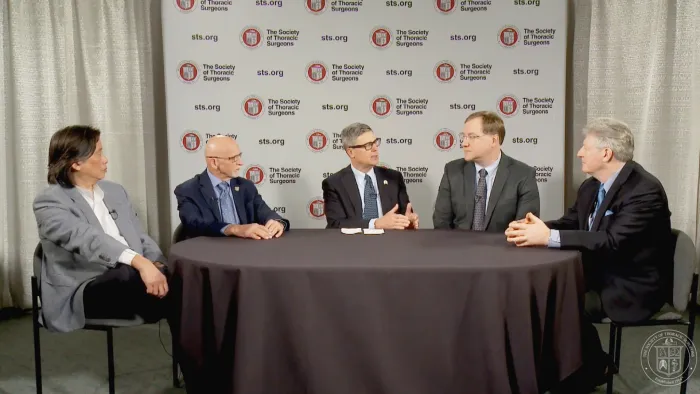
Lung cancer morbidity and mortality remains high in the United States and beyond despite major changes over the past few years in early detection and treatment for advanced disease. Dr. Douglas E. Wood, from the University of Washington in Seattle, moderates a roundtable discussion with prominent lung cancer surgeons—Drs. Shanda H. Blackmon, Lisa M. Brown, and Mitchell J.

An important element of building and maintaining a successful cardiothoracic surgery practice is the relationship with referring physicians such as cardiologists and primary care physicians. V.

As the Centers for Medicare & Medicaid Services reevaluates the scientific evidence supporting volume requirements for hospitals and heart team members who perform transcatheter aortic valve replacement (TAVR) procedures, an esteemed panel of TAVR experts gathered on January 27, 2019, to discuss the value of The Society of Thoracic Surgeons (STS)/American College of Cardiology (ACC) Transcatheter Valve Therapy (TVT) Registry for quality improvement initiatives, outcomes research, and device surveillance. Their discussion, “TAVR and the Value of the STS/ACC TVT Registry,” was led by Dr.

Lung cancer morbidity and mortality remains high in the United States and beyond despite major changes over the past few years in early detection and treatment for advanced disease.
25 min.