- Cardiothoracic surgery faces workforce and practice challenges that require systemic solutions.
- Healthier, psychologically safe practice environments support both surgeon well-being and patient care.
- The future depends on developing, supporting, and retaining surgeons throughout their careers.
- Mentorship, leadership, and connection are essential to a stronger, more sustainable specialty.
- Despite today’s challenges, cardiothoracic surgery has evolved significantly and has a bright future.
The opinions expressed in this article are those of the author and do not necessarily reflect the views of The Society of Thoracic Surgeons.
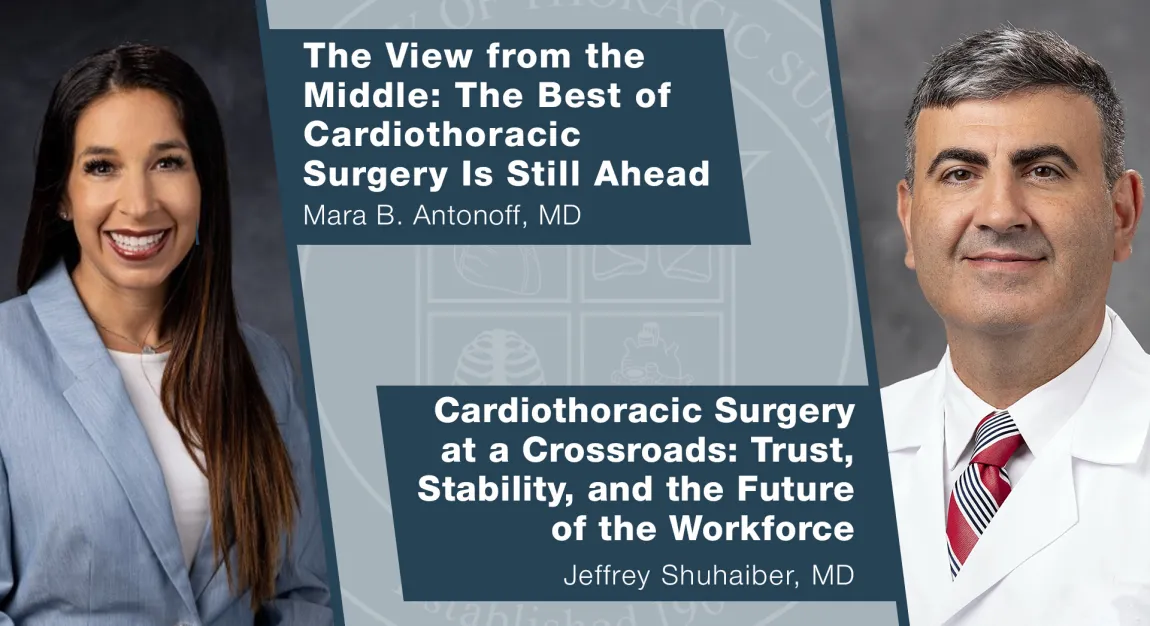
Cardiothoracic Surgery at a Crossroads: Trust, Stability, and the Future of the Workforce
Jeffrey Shuhaiber, MD
We entered this specialty knowing it would be challenging yet deeply rewarding. The hours, the weight of the operating room, the conversation with a family when things did not go as planned—we accepted all of it. What many of us did not anticipate was a different kind of difficulty: trying to practice, grow, and lead inside systems that are themselves under profound strain.
The numbers now confirm what many surgeons have long felt quietly. HRSA projects a 31 percent shortfall of cardiothoracic surgeons by 2035—the largest projected shortfall of any physician specialty it evaluated1. A recent survey of cardiothoracic surgeons found that 40.9 percent of respondents had experienced bullying during their careers2. And our specialty has become overwhelmingly institutional: more than three-quarters of thoracic surgeons now practice in hospital-based or academic settings, with independent private practice increasingly the exception3—part of a wider shift across U.S. medicine, where the share of physicians in wholly physician-owned practices fell from 60.1 percent in 2012 to 42.2 percent in 20244.
These are not abstract statistics. They are the background behind surgeons who keep working, keep covering, and quietly wondering what kind of support will allow them to keep serving.
Consolidation has reshaped our labor market in ways we are still learning to name honestly. In many regions, one or two dominant systems may function as the only realistic employers. Restrictive covenants and noncompete agreements—which the Society of Thoracic Surgeons has recognized as a barrier to specialized care—can make mobility and career recovery more difficult1.When programs merge, volumes shift, contracts change, and reporting structures are realigned, a surgeon's professional life can be disrupted not because of a failure of commitment or character, but because the system around the surgeon changed.
When surgeons cannot raise concerns early and honestly, the consequences are rarely confined to the individual. Psychological safety—the lived ability to raise a concern, ask for support, or say “this environment is not working” without fear of professional consequence—is not simply a wellness concept. It is operational. Its absence affects teams, outcomes, and the people who hold everything together5. We were trained to project steadiness. That training saves lives in the operating room. Outside it, it can delay honest conversations until the cost of not having them becomes very high.
Commercial aviation faced a similar reckoning. In the 1970s, catastrophic failures occurred not because pilots lacked skill, but because cockpit culture made it difficult to challenge authority. Aviation's answer was not to demand more toughness. It was to redesign the system. Crew Resource Management—formalized after a 1979 NASA workshop—flattened authority gradients and made speaking up an expectation rather than an act of courage, helping transform flying into one of the safest endeavors in modern life6. Surgery borrowed aviation's checklists. We have been slower to borrow its deeper lesson: excellence is fragile when the culture around it makes honesty difficult.
Our field is facing its own version of that reckoning. None of this is anyone's fault. Hospitals are navigating genuine financial, staffing, and regulatory pressures of their own. But the absence of blame does not mean the absence of responsibility. Asking surgeons to be more resilient without examining the structures around them is incomplete. Strengthening those structures is part of leadership.
The remedies are not novel, and I have argued for them at greater length elsewhere: transparent expectations before recruitment; honest conversations when difficulties arise; compensation that rewards outcomes and relationships, not volume alone; governance that distributes operative opportunity and builds succession; peer review that is educational rather than punitive; and mentorship that is protected, consistent, and real7.
This is also a call to how we treat one another. We should be careful not to mistake a linear resume as the only marker of reliability. We can hold high standards without personal diminishment. We can review complications without reducing a colleague to one. We can recognize that a non-linear career—shaped by research, family constraints, locum work, program rebuilding, or the search for a better fit—may reflect resilience rather than risk.
Some of the most capable surgeons I know are those who had to rebuild, who stepped into coverage roles when programs needed help, and who kept operating through transitions that would have unsettled anyone. Their records may show movement; their work shows endurance.
Before any policy changes, each of us can treat the colleague whose path looks unconventional, or who is quietly struggling, as a full peer worth keeping—in the hallway, in the hiring committee, and in credentialing review. That shift costs nothing, and it is where every durable culture begins.
The future of our specialty will not be determined by innovation alone. It will be determined by whether we build environments where good surgeons can find a stable place to contribute, recover, grow, and lead at different stages of their careers. That is a workforce question, a patient-safety question, and a question of who we choose to be for one another.
We have mastered the training of exceptional cardiothoracic surgeons. The next challenge is workforce stewardship: the deliberate work of supporting, retaining, and developing surgeons through the transitions, disappointments, recoveries, and renewals of a long career. The future of our specialty may depend not only on producing exceptional surgeons, but on building environments worthy of their long-term commitment.
A humane specialty is not a weaker one. It is a more durable one. And in surgery, durability is what keeps patients safe—and allows good surgeons to keep serving.
Dr. Shuhaiber is a practicing cardiovascular surgeon and physician-investigator in Boston. He is the author of “Ethical Leadership in Cardiothoracic Surgery in an Era of Consolidation: A Framework for Trust, Transparency, and Workforce Stability,” published in the May 2026 issue of The Journal of Thoracic and Cardiovascular Surgery.
References
1. The Society of Thoracic Surgeons. Advocacy issue: physician workforce [Internet]. Chicago: The Society of Thoracic Surgeons; 2026 [cited 2026 May 31]. Available from: https://www.sts.org/advocacy-issue-physician-workforce
2. Sydorenko AY, Spindler H. Exploring bullying in cardiothoracic surgery: the role of psychological safety and personal traits. Cardiol Young. 2024;34(9):1-5. doi:10.1017/S1047951124025198
3. Daniel J, DeCamp M, Romano J, Tong B, Moulton M, Mitchell J, et al. Understanding our thoracic surgery workforce: who, what, and where we practice. JTCVS Open. 2025;28:760-767. doi:10.1016/j.xjon.2025.08.016
4. Kane CK. Physician practice characteristics in 2024: private practices account for less than half of physicians in most specialties [Internet]. Chicago: American Medical Association; 2025 [cited 2026 May 31]. Available from: https://www.ama-assn.org/system/files/2024-prp-pp-characteristics.pdf
5. Edmondson A. Psychological safety and learning behavior in work teams. Adm Sci Q. 1999;44(2):350-383. doi:10.2307/2666999
6. NASA Aviation Safety Reporting System. Crew resource management [Internet]. Moffett Field (CA): NASA ASRS; 2003 [cited 2026 May 31]. Available from: https://asrs.arc.nasa.gov/publications/callback/cb_279.htm
7. Shuhaiber J. Ethical leadership in cardiothoracic surgery in an era of consolidation: a framework for trust, transparency, and workforce stability. J Thorac Cardiovasc Surg. 2026;171:1169-1176. doi:10.1016/j.jtcvs.2026.02.010
The View from the Middle: The Best of Cardiothoracic Surgery Is Still Ahead
Mara B. Antonoff, MD
The opinions expressed in this article are those of the author and do not necessarily reflect the views of The Society of Thoracic Surgeons.
I am living in the sandwich generation in more ways than one. At home, I am navigating the nuances of aging parents, grade-school children, and young-adult children who still need me in entirely different ways. Professionally, I have begun to realize that I occupy a similarly interesting middle ground. I am far enough into my career to have watched our specialty change in meaningful ways, but spend substantial time interacting with residents, fellows, and junior colleagues who are actively shaping the next era of our specialty. At the same time, I work alongside senior partners, mentors, and professional leaders whose experiences have given me an enormous appreciation for how far cardiothoracic surgery has already evolved.
This view from the middle leaves me extraordinarily optimistic.
I can see backward and forward at the same time. I remember enough of the culture in which I trained to recognize how profoundly expectations around mentorship, leadership, collaboration, and professional fulfillment have changed. I also see the next generation arriving with enormous technical ambition, scientific curiosity, and a willingness to ask questions that many of us did not know how to ask early in our careers. They are not lowering the bar; in many ways, they are raising it by demanding excellence in the operating room as well as a professional culture capable of sustaining excellence over an entire career.
Optimism does not require ignoring challenges and obstacles. Cardiothoracic surgery faces a projected workforce shortage.1 Surgeons are practicing within increasingly complex health care systems. Concerns regarding burnout, bullying, professional isolation, career mobility, and loss of autonomy have gained awareness and merit thoughtful attention.2 We should be transparent in acknowledging elements of our environments that have impeded talented surgeons from flourishing, and we can be intentional about how we approach those hurdles. My optimism does not stem from oblivion to our challenges, but rather from satisfaction in our willingness to name those challenges and to have candid discussions aiming to openly address them. Conversations that may have historically occurred quietly are increasingly becoming catalysts for thoughtful change and impetus for progress.
From where I sit, the future looks exceptionally bright.
I am fortunate to have the privilege of mentoring a number of trainees and early-career surgeons, and these interactions make me enormously hopeful. These talented men and women are technically ambitious, scientifically curious, and far more intentional about relationships, wellness, and workplace culture than most of us knew how to be early in our careers. They expect excellence of themselves and of others. They expect thoughtful leadership and an environment in which asking for help is interpreted as maturity rather than weakness. I am beyond grateful for this healthy shift. I am grateful as a daughter for opportunities that were not afforded my parents, and I wish nothing but even greater possibilities for my own children. Likewise, in my career, I sit on the shoulders of giants who have achieved so much, yet my greatest wishes are for my trainees and protégés to achieve far more than I do, in an environment that enriches their happiness and health.
I have witnessed the ways in which careers can change when people invest in one another. The value of mentorship throughout a career in cardiothoracic surgery is well established.3 I have experienced its impact personally, having been the beneficiary of generous mentorship and sponsorship. Likewise, some of the most gratifying moments of my career have involved watching individuals whom I mentored gain confidence, meet collaborators, receive accolades, and discover professional paths that they hadn’t previously imagined. Those relationships have changed what I believed was possible for me, and I derive great joy from creating similar possibilities for others.
My perspective is notably shaped by my involvement with the Society of Thoracic Surgeons. As Chair of the Council on Member Engagement, I have the privilege of learning from surgeons across career stages about their unmet needs and working with phenomenal teams to consider how our professional organization has opportunities to serve and support our own community. I witness how very much intentional work is underway at the STS to support mentorship, leadership development, wellness, inclusion and belonging, career development, practice sustainability, and meaningful professional connections.
The STS recognizes the importance of surgeon-to-surgeon connections and networking. Our Mentorship Program connects members across career stages. The Leadership Institute provides early and mid-career surgeons focused training in leadership, negotiation, career development, and managing change. Programs such as the You Belong Scholarship and Looking to the Future Scholarship bring medical students and residents into our community early, pairing exposure with mentorship rather than hoping interest develops serendipitously. Within the Council on Member Engagement, our efforts span career development, wellness, inclusion and belonging, cardiothoracic practice, allied health integration, and the Nina Starr Braunwald Center. This breadth of activities comes together as a portfolio reflecting deliberate investment in the people who constitute our specialty—now and in the future.
Beyond activities to engage directly with the members, STS advocacy addresses physician workforce capacity, mobility, reimbursement, administrative burden, and policies that affect surgeons building sustainable careers. These efforts do not provide a magical solution or erase all obstacles in our way. They do, however, demonstrate that workforce stewardship is being treated as substantive, continuous work rather than a quick fix. I find tremendous encouragement in the breadth of these efforts and the resources committed to the work. I wholeheartedly believe that the pressures facing our workforce create opportunities to rethink how we recruit, retain, support, and advocate for cardiothoracic surgeons in ways that may ultimately make our specialty stronger. Each challenge that we identify gives us another chance to build a profession in which extraordinary surgeons can remain engaged, fulfilled, and excited about their work across an entire career.
My optimism stems from seeing this great work, and from seeing the people who are committed to the field. I see senior surgeons opening doors for younger colleagues. I see trainees asking insightful questions about how we can practice better. I see colleagues advocating for one another after setbacks and helping people rebuild careers rather than defining them by their most difficult chapter. I see surgeons finding new ways to contribute through clinical care, research, education, advocacy, and leadership. Our specialty is changing, and much of that change is for the better. From my vantage point in the middle, I have the privilege of learning from the generation who preceded me while investing in the generations coming behind me. The evolution is in my face, and it’s energizing.
Cardiothoracic surgery has never been easy, nor did any of us enter this field to achieve aspirations of ease. The work is hard and it is rewarding. We fight hard battles to prolong lives and to save lives. Inherent in our work are elements that are technically complex, physically demanding, intellectually challenging, and emotionally exhausting. Yet we choose to remain humane, community-focused, and this is why we will remain sustainable. We are raising the bar, demanding the best in ourselves and better supporting the people who choose to give their lives to this calling.
From the middle, I can see enough of where we have been to appreciate how much has changed, and enough of what is ahead to be exhilarated by where we are going. The challenges facing our workforce are as real as the opportunities that they have created. We are called to mentor more intentionally, to lead more thoughtfully, to build healthier teams, to broaden the ways that surgeons can contribute, and to be more deliberate about the professional culture that we promote.
When I look to the future, I see extraordinary trainees, deeply committed colleagues, and a specialty willing to examine itself and evolve. I see momentum, possibility, and every reason for confidence.
From the middle, the future looks very bright, and I am confident that the best of cardiothoracic surgery is still ahead.
Dr. Antonoff is Chair of the STS Council on Member Engagement and an Associate Professor in the Division of Thoracic Surgery, Department of Surgery, at Cedars-Sinai Medical Center.
References:
1. Moffatt-Bruce SD, Crestanello J, Way DP, Williams TE Jr. Providing cardiothoracic services in 2035: Signs of trouble ahead. J Thorac Cardiovasc Surg. 2018;155(2):824-829. doi:10.1016/j.jtcvs.2017.09.135.
2. Sydorenko AY, Spindler H. Exploring bullying in cardiothoracic surgery: the role of psychological safety and personal traits. Cardiol Young. Published online October 23, 2024:1-5. doi:10.1017/S1047951124025198.
3. Odell DD, Edwards M, Fuller S, Loor G, Antonoff MB; Society of Thoracic Surgeons Workforce on Career Development. The art and science of mentorship in cardiothoracic surgery: a systematic review of the literature. Ann Thorac Surg. 2022;113(4):1093-1100. doi:10.1016/j.athoracsur.2020.06.051.