
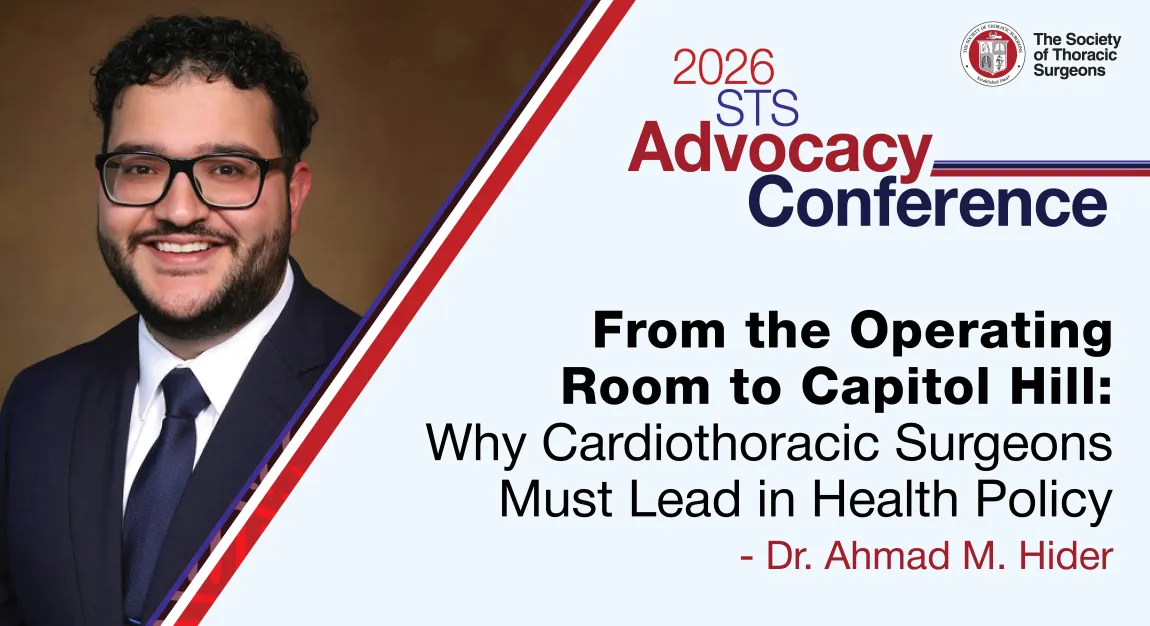
- Policy decisions directly shape surgical outcomes and access to care.
- Physician advocacy is essential—not optional—for the future of surgery.
As a surgical resident, I am trained to focus on what is immediately in front of me, the patient, the operation, the outcome. But stepping into a congressional office as part of STS's advocacy efforts offered a stark reminder: many of the factors that shape our patients’ outcomes are determined far beyond the walls of the operating room.
Having participated in STS advocacy efforts in both 2025 and 2026, I had the opportunity to engage directly with policymakers on issues that are central to the future of cardiothoracic surgery. In recent years, our group has met with the teams of Representative Gabe Evans and Senators Michael Bennet and John Hickenlooper, highlighting the importance of sustained, bipartisan engagement on issues that affect surgical care. Under the mentorship of Joseph Cleveland, MD, John Mitchell, MD, and Robert Meguid, MD, I came to appreciate that effective advocacy is not just about representing our field, it is about translating the realities of patient care into policies that improve outcomes at scale.
During these visits, we focused on three key priorities: expanding access to cancer screening through mobile units, addressing Medicare reimbursement changes affecting cardiothoracic surgeons, and supporting robust National Institutes of Health (NIH) funding. What struck me most was not just the substance of these issues, but how directly they influence the care we deliver every day.
One of the most compelling discussions centered on the Mobile Cancer Screening Act, which aims to expand access to early cancer detection, particularly in rural and underserved communities where hospital-based screening programs are limited. As surgeons, we often encounter patients whose disease could have been treated earlier, more effectively, and at lower cost if detected sooner. This legislation proposes targeted investments, up to 2 million dollars per site and 15 million dollars annually, to bring screening directly to patients. It is a powerful reminder that improving surgical outcomes often begins long before a patient reaches the operating table.
Equally important was the conversation surrounding recent changes to Medicare reimbursement. A new Centers for Medicare & Medicaid Services policy implemented in 2026 reduces work Relative Value Units for cardiothoracic surgeons by 2.5 percent, with additional cuts planned in the coming years. While these adjustments may appear incremental, their cumulative impact on surgical practice, workforce sustainability, and patient access is significant. Advocacy efforts to delay this policy are not simply about reimbursement, they are about preserving access to highly specialized surgical care, particularly in regions already facing workforce shortages.
Finally, we emphasized the critical importance of sustained NIH funding, not just as a national priority, but as a direct investment in the health and economy of states such as Colorado. In Colorado alone, NIH funding supports approximately 579.5 million dollars in research activity, sustains over 6,800 jobs, and drives more than 1.6 billion dollars in economic activity. These investments fuel innovation at leading institutions such as the University of Colorado and National Jewish Health, while also supporting a broader bioscience ecosystem comprising tens of thousands of jobs statewide.
For patients, this funding translates into real impact. Cardiovascular disease and cancer remain leading causes of mortality in Colorado, with annual death rates exceeding 120 per 100,000 for both conditions. Advances in early detection, perioperative care, and surgical innovation, many of which are driven by NIH supported research, are essential to improving these outcomes. Without sustained federal investment, the progress we rely on as surgeons, and that our patients depend on, would slow.
What became clear through these conversations is that policymakers are receptive, but they rely on physicians to translate clinical reality into actionable policy priorities. As a trainee, I was struck by how much our perspectives are valued in these discussions. Data and statistics matter, but so do stories, the patient who presents too late due to lack of screening, the hospital struggling to maintain a cardiothoracic program under financial strain, the missed opportunity for innovation when research funding stagnates.
For trainees and early career surgeons, it is easy to view advocacy as peripheral to clinical practice. In reality, it is essential. Policies governing reimbursement, research funding, and access to care are not abstract, they shape who receives surgery, when they receive it, and what outcomes we can achieve. Engaging in advocacy is not a departure from our role as surgeons—it is an extension of it.
As our healthcare system continues to evolve, cardiothoracic surgeons must play an active role in shaping the policies that define our field. Whether through organized efforts like STS advocacy or individual engagement with local and national leaders, our voices carry weight. The future of surgical care will not be determined solely in the operating room; it will also be shaped in conversations like those taking place on Capitol Hill.