Video file

Education

Network and Stay on the Cutting Edge of Cardiothoracic SurgeryView All >
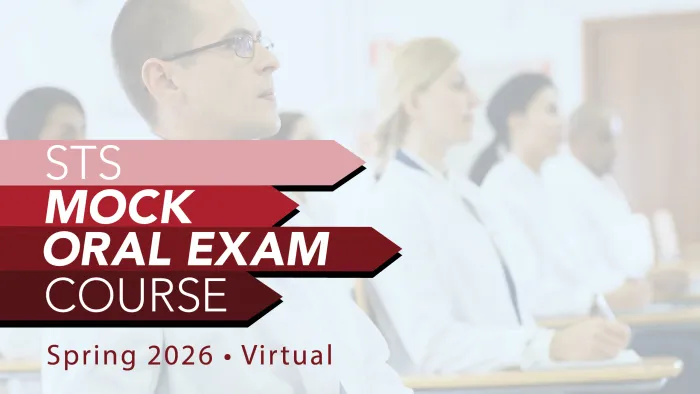
Demystify the Oral Board Exam with STS Prep
Event dates
Apr 21 – May 28, 2026
Location
Virtual
An opportunity for early and mid-career STS surgeon members to learn how to lead in and out of the OR.
Event dates
Apr 24, 2026 – Jan 27, 2027
Location
Virtual, Chicago, and San Diego
Performing as our best selves as cardiothoracic surgeons both inside and outside of the workplace
Event dates
Apr 28, 2026
Location
Virtual

News & Media

The Latest from the Field of Thoracic SurgeryView All >

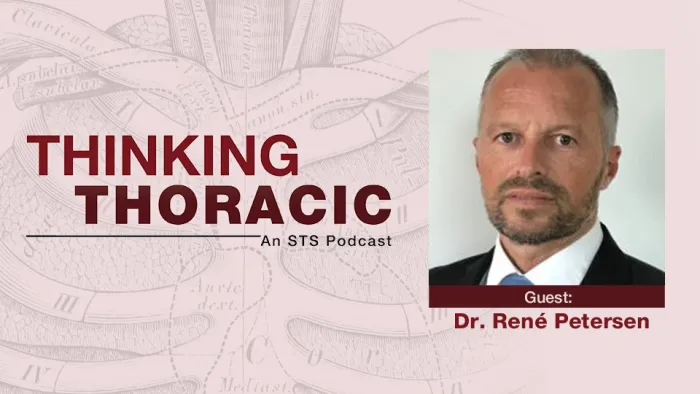
In this episode of Thinking Thoracic, podcast hosts Hari Keshava, MD, and Erin Gillaspie, MD, talk with J. W.

40 min.

In this episode, hosts Dr. Sara Pereira and Dr. Cherie Erkmen talk with guest Dr. Gianluigi Bisleri to reflect on his early training in Italy, a once-imagined path in music, and his fellowship at Columbia University. He shares insights from leadership roles across Europe and Canada, discussing his work advancing minimally invasive valve and atrial fibrillation surgery, training as a left-handed surgeon, and building programs from the ground up.

42 min

Cardiothoracic professionals from around the world gathered at the 62nd Annual Meeting of The Society of Thoracic Surgeons (STS) in New Orleans, held January 29 – February 1, 2026.

This year’s theme, “Teaching for Tomorrow Together,” guided the meeting’s focus on emerging data and clinical debates, along with an enhanced, multisensory learning experience designed to engage surgeons at every stage of their careers.

Adult Cardiac Surgery Sessions

Image
Dr. John Puskas

Presentations featured the J. Maxwell Chamberlain Memorial Paper, which offered a randomized comparison of coronary artery bypass grafting guided by CT-derived fractional flow reserve versus traditional angiography, providing insights into how advanced imaging may improve surgical decision-making. The Clark Paper examined the management of moderate aortic stenosis in patients undergoing bypass surgery. Additional sessions explored strategies for managing new-onset atrial fibrillation after cardiac surgery, the growing challenge of transcatheter aortic valve explantation, and the benefits of mitral valve repair over replacement in patients over age 65. Presentations also highlighted one-year results from endovascular repair of aortic arch lesions using a thoracic branched endoprosthesis, offering new data on its role relative to open surgery, and evaluated whether prophylactic left atrial appendage occlusion reduces stroke risk in older patients without atrial fibrillation.

General Thoracic Surgery Sessions

The General Thoracic sessions addressed critical issues in the management of patients with esophageal and lung cancers, highlighting evolving strategies to improve surgical outcomes and cancer care. The Clark Paper evaluated nodal upstaging rates and morbidity associated with the ACS Commission on Cancer Operative Standard 5.8, comparing it with other commonly used lymph node sampling guidelines using data from the STS General Thoracic Surgery Database. The J. Maxwell Chamberlain Memorial Paper explored the relationship between nodal assessment, pathological upstaging, and survival in patients with clinically node-negative non-small cell lung cancer undergoing resection, offering insights into the prognostic value of thorough lymph node evaluation. Other sessions examined the extent of nodal resection, upstaging rates, and outcomes associated with evaluating more than a single N1 lymph node, evidence-based guidelines for defining and performing sublobar resection, and strategies for determining the most effective interventions for screen-detected lung nodules.

Congenital Heart Surgery Sessions

Image
Dr. Elaine Griffeth

Presentations in the congenital heart surgery sessions included innovative strategies and evolving technologies aimed at improving outcomes in congenital heart care. The James S. Tweddell Memorial Paper featured an institutional machine learning model used to predict postoperative morbidity and mortality in adult congenital heart disease patients undergoing cardiac reoperations, demonstrating the potential of artificial intelligence in managing complex, high-risk populations. Another session introduced a novel technique for heart procurement in donation after circulatory death, addressing ethical considerations while helping expand the donor pool. The Clark Paper also examined the impact of preoperative tracheostomy on outcomes following congenital cardiac surgery, using data from the STS Congenital Heart Surgery Database to inform perioperative risk assessment.

Perioperative & Critical Care Sessions

Highlights included The J. Maxwell Chamberlain Perioperative Paper, which analyzed the effect of expedited discharge on 30-day readmission rates following lung resection, offering a national comparison between robotic-assisted and video-assisted thoracoscopic approaches. Sessions also featured discussions on real-time clinical decision-making in the management of vasoplegia and explored minimally invasive cardiac surgery within the context of enhanced recovery protocols. Additional topics included strategies for managing severe postoperative anemia in patients who decline blood transfusions, evolving techniques for routine versus selective distal perfusion in VA ECMO, the use of multimodal virtual reality combined with olfactory stimuli to reduce perioperative pain and anxiety in thoracic surgery patients, and best practices for first-line treatment of cardiac arrest following surgery.

Celebrating Outstanding Women CT Surgeons

Image
Extraordinary Women in CT Surgery Award winners

More than 240 attendees gathered for the fourth annual Nina Starr Braunwald Extraordinary Women in Cardiothoracic Surgery Awards breakfast to honor women cardiothoracic surgeons who have exhibited exceptional clinical expertise and made significant contributions to the specialty. This year’s recipients were Emily Farkas, MD, Indiana University School of Medicine and the Richard L. Roudebush VA Medical Center in Indianapolis; Carolyn Jones, MD, University of Rochester Medical Center; and Rosemary Kelly, MD, University of Minnesota Medical School and MHealth Fairview.

Reflections on Leadership and the Future of Surgery

STS President Joseph F. Sabik III, MD, delivered the presidential address, highlighting his career, personal milestones, and the evolving future of cardiothoracic surgery and the Society. Through stories and insights, Dr. Sabik shared the experiences that shaped his leadership and vision.

Main Stage Voices Inspired and Challenged at STS 2026

At STS 2026, attendees heard from dynamic speakers who offered insight on leadership, teamwork, and performance under pressure.

Image
Shola Richards

The Vivien T. Thomas Lecture was given by bestselling author Shola Richards. In his talk, “The Courage To Go Together™: Three Questions to Change How You Work, Live, and Lead,” he introduced a framework for building psychological safety and seamless coordination—capabilities essential for cardiothoracic surgical teams striving for optimal patient outcomes.

Two-time World Series Champion Terry Francona delivered a plenary address on leadership in adversity. In “From the Dugout to the OR: The Art of Building a Winning Team,” he shared lessons on building trust, navigating challenges, and staying focused on a common goal.

Globally recognized Peloton instructor Ben Alldis also took the stage, presenting his plenary talk, “Auditing Your Well-Being.” He offered practical strategies for maintaining peak performance, prioritizing well-being, and sustaining motivation in high-demand environments.

The Hub Sharpens Skills and Builds Connections

Image
The Hub at STS 2026

For the third consecutive year, The Hub served as a central gathering space for early-career surgeons, medical students, residents, and fellowship trainees. The lounge area hosted a wide range of engaging sessions, including the White Coat Investor Talk, Mock Oral Interviews, Job Interview Preparation, and a luncheon celebrating the 20th Anniversary of the Looking to the Future Scholarship Program, among others. Attendees also took part in creative activities within The Hub, such as the collaborative mural project “Splashes of Hope.” Through this initiative, participants contributed their creativity to a piece of artwork that will be donated to a local children’s hospital.

Immersive Surgical Training

STS 2026 featured practical, hands-on courses covering a range of surgical procedures throughout the Annual Meeting, providing an engaging, immersive learning experience for residents, early-career surgeons, and others looking to sharpen their skills. Topics included aortic annular enlargement, TEVAR techniques for aneurysms and dissections, mitral valve repair, complex central airway reconstruction, and the Ross procedure.

Cutting-Edge Science and Live Podcast Conversations

Image
Same Surgeon, Different Light at STS 2026

The STS Annual Meeting exhibit hall featured more than 130 exhibitors showcasing the latest tools and technologies for surgical practice, along with live, hands-on product demonstrations. Industry symposia provided valuable insights into emerging techniques, innovations, and interventions shaping the future of cardiothoracic surgery. The exhibit hall theaters provided attendees with the opportunity to experience live podcast recordings of Thinking Thoracic, The Resilient Surgeon, and Same Surgeon, Different Light, interactive industry presentations, and the CT Surgery Resident Showdown.

Mar 19, 2026
5 min read
Image
STS News Banner

STS News, the Society’s quarterly magazine for members only, brings you the latest CT surgery news, research, stories, and more to help keep you in the know and connected to your peers.

Read the issue

Member Voices

Ian Bostock Rosenzweig, MD, MS
Get comfortable with rejection and hearing 'no' from every direction. But ultimately, you have to say 'yes' to yourself.
Ian Bostock Rosenzweig, MD, MS
Vice Chair, Workforce on Inclusion and Belonging