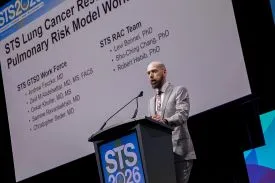
As part of the “Research in Focus: Landmark Science & Technology” session on day one of the STS meeting, Andrew Feczko, MD, of Cleveland Clinic presented the STS Landmark paper titled Lung Cancer Resection Longitudinal Risk Model. In his presentation, Dr. Feczko described the development and validation of a robust, data-driven model designed to predict long-term survival following curative-intent lung cancer resection—an area of growing importance as survival improves and quality benchmarking extends beyond perioperative outcomes.
Drawing on the Society of Thoracic Surgeons General Thoracic Surgery Database, the investigators analyzed outcomes from a large, contemporary cohort of adults who underwent lung cancer resection. By linking STS data with national mortality sources, the team was able to assess survival over an extended follow-up period and construct individualized risk predictions across pathologic stages. Patients were divided into derivation and validation cohorts to ensure the model’s generalizability, and advanced statistical techniques were used to account for differences in risk over time.
The resulting longitudinal risk model demonstrated strong discrimination and excellent calibration, accurately aligning predicted survival with observed outcomes across multiple time points and disease stages. Risk scores were closely associated with long-term survival, effectively stratifying patients into distinct prognostic groups. Importantly, the model’s performance improved further when postoperative complications were incorporated, highlighting the lasting impact of perioperative events on long-term outcomes.
Dr. Feczko emphasized that this work addressed a critical gap in thoracic surgery by extending risk assessment beyond short-term mortality. As the field increasingly focuses on survivorship, quality improvement, and informed shared decision-making, the availability of validated long-term survival models represents a significant advance.
With this study, the STS General Thoracic Surgery Database now offers thoracic surgeons both short- and long-term risk prediction tools to support self-evaluation, programmatic quality improvement, and future research—reinforcing its role as the authoritative national resource for thoracic surgical outcomes.