
NEW ORLEANS—January 31, 2026—A nationwide, real-world analysis using the STS General Thoracic Surgery Database (GTSD) from 2012 to 2023, analyzed 16,056 adults who underwent esophagectomy for primary esophageal cancer to develop and validate a long-term all-cause mortality risk model. The study, undertaken by the STS General Thoracic Surgery Database Workforce, demonstrates that a stratified multivariable Cox model incorporating clinicopathologic factors, including postoperative complications, can reliably predict 1-, 5-, and 10-year survival in all types of esophagectomy patients across the American Joint Committee on Cancer 8th edition stages and neoadjuvant treatment status.
The study represents the largest analysis of national-scale real-world clinical data (i.e., GTSD) with longitudinal vital status follow-up examined and modeled long-term after all forms of esophagectomy for esophageal cancer.
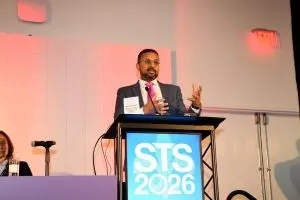
“This is a truly remarkable piece of work that is unique because it gives us the most complete picture that we have ever had of long-term survival for surgically-treated esophageal cancer patients,” said Biniam Kidane, MD, MSc, of the University of Manitoba, lead author on the study. “The GTSD is one of the most reliable perioperative risk-adjusted datasets in the world for esophagectomy. By combining it with robust long-term data from national sources (CMS and National Death Index), we get the best of both worlds to leverage a unique and powerful dataset that can be used by clinicians and patients to make truly informed shared decisions.”
Dr. Kidane and the research team developed a comprehensive and highly performing survival-risk model that integrates patient factors, clinicopathologic characteristics, neoadjuvant therapy status and response, pathologic stage, as well as incorporating the impact of postoperative complications.
Key findings emphasize how 10-year survival probabilities vary by pathologic stage and by neoadjuvant treatment response. Ten-year survival was 44.7% for stage I, 32.6% for stage II, 20.3% for stage III, and 14.4% for stage IV disease. Among patients who received neoadjuvant therapy, the overall pathological complete response (pCR) rate was 19.0% (adenocarcinoma 17.0%; squamous cell 34.2%), with 10-year survival of 44.5% for those achieving pCR versus 27.6% for those who did not.
This STS-developed all-inclusive model for long-term outcomes of esophageal cancer resection surgery combines patient characteristics, disease biology, treatment factors, and surgical details to allow for precise longitudinal survival estimation. Once implemented as a decision tool, it will allow surgeons to generate individualized survival prognosis for up to 10 years and will provide a data-driven framework to support patient counseling, risk stratification, and follow-up planning within programs contributing to the STS National Database.
About STS
Founded in 1964, The Society of Thoracic Surgeons is a not-for-profit organization representing more than 8,000 cardiothoracic surgeons, researchers, and allied healthcare professionals worldwide who are dedicated to ensuring the best possible outcomes for surgeries of the heart, lung, and esophagus, as well as other surgical procedures within the chest. The Society’s mission is to enhance the ability of cardiothoracic surgeons to provide the highest quality patient care through education, research, and advocacy.