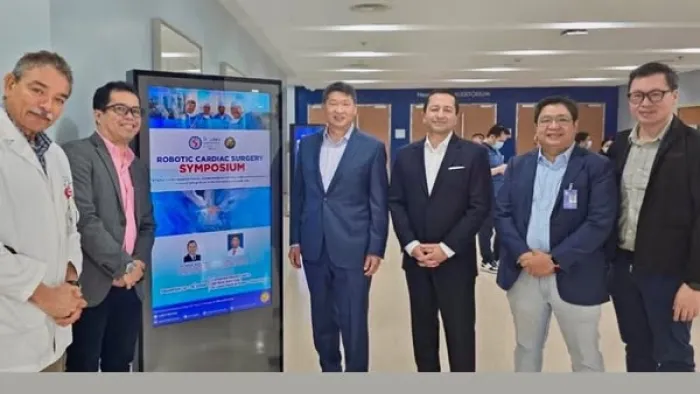
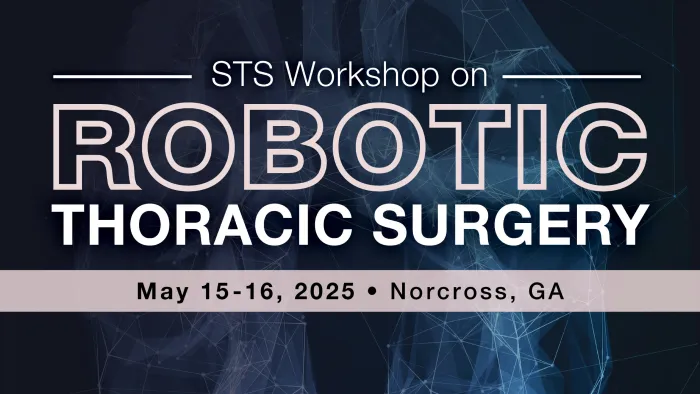
The STS Workshop on Robotic Cardiac Surgery held May 9-10 in Peachtree Corners, Ga., offered 80 surgeons from across the country two days of hands-on team training for mitral valve repair, coronary bypass, and other surgery procedures in a cardiac robotics simulation environment.

"Robotics conference attendees"
Workshop attendees gained insight into building a robotics program, as well as improving the effectiveness of their program.

Here are the top five benefits that surgeon attendees received from the experience:

1. Innovation: Attendees trained in robotic mitral valve procedures and robotic coronary revascularization using the latest techniques and technology. Multiple operating bays fitted with surgical robots allowed participants to sit at the console to control the robots.  

2. Training: The program offered a variety of educational activities for surgeons, including real-world simulations, case videos, faculty discussions, emphasized patient selection, perioperative management and postoperative care, and operative techniques.

3. Collaboration: The workshop was designed for both beginner robotic surgical teams who are looking for fundamental information and guidance on how to build a program, as well as advanced robotic surgical teams already practicing cardiac surgery robotics and are looking to continually improve the efficiency and effectiveness of their program.  

4. Access to luminary experts in the field: The workshop was led by world-renowned robotic heart surgeons. The surgeons who served as faculty not only mastered the use of robotics in cardiac surgery, but they also helped define it. 

5. Networking: Robotic Cardiac Surgery Workshop attendees connected with surgeons from across the country who are on the cutting edge of robotic cardiac surgery. 

Feedback on the conference was overwhelmingly positive. Here are a few highlights:

  • "The best presentation was the one on preoperative criteria and assessment for robotic mitral valve patients." 
  • "The session content was helpful for those thinking about starting a robotic mitral valve program." 
  • "The presentations given by early-stage faculty on difficult cases where they had to convert to open were very helpful." 
  • "Dr. Joanna Chikwe's session on complications of mitral valve repairs was wonderful.  I loved this presentation."
  • "The most valuable sessions were those that offered peer-to-peer interaction with the experienced surgeons, including the hands-on lab."
  • "I think the courses being part lecture and part hands-on gave the background and data to support what we are doing in the lab.  Even more hands-on time would be great, as well."
     
May 30, 2024
2 min read

In this 8x8 video (presented in Spanish), Dr. Juan Crestanello, chief of cardiac surgery at Mayo Clinic in Rochester, MN, discusses annular disjunction of the mitral valve, its medical and surgical implications, and also the operative techniques used to deal with this anatomical feature.

Duration
7 min.

STS is pleased to announce the release of the Adult Cardiac Surgery Database Executive Dashboard Report, now available on the Database platform. The Executive Dashboard includes the following components:

  • The participant’s star ratings for the last six star-rating periods, allowing you to easily track your site’s risk-adjusted performance longitudinally.
  • Resource utilization metrics for isolated coronary artery bypass grafting (CABG) procedures, which provide participants near real-time data vs. STS benchmark data from the previous analysis period, including: 
    • ICU times
    • Postoperative total ventilation hours
    • Postoperative length of stay
    • Total blood project usage (intraoperative/postoperative)
  • Participant’s performance on meeting inclusion eligibility criteria. Utilizing green, yellow, and red statuses and convenient drill-down functionality, participants can easily identify cases of concern and save valuable time. And case counts are available to allow users to verify if their site meets case count requirements for analysis. Updates to this report are ongoing to provide real-time data. Refer to the Notifications tab on the IQVIA Platform for updates. 

Additional procedure types for resource utilization metrics were released on April 13, 2024. More utilization metrics are being considered. If you have a suggestion, contact Carole Krohn at ckrohn@sts.org.
 
If you have questions regarding the Database, contact the STS Database Help Desk.

May 1, 2024
1 min read

Stand Out Among Your Competitors & Partners 

Increase your company’s opportunity for personalized interactivity with attendees by exhibiting at the Workshop. Several breaks will take place in the exhibit area and have been scheduled so that attendees have plenty of time to visit your booth. The intimate size of the exhibition will help ensure that you have quality access to meeting attendees. 

Exhibitors also are eligible to purchase symposia, email blast communications, and/or to support the meeting with an educational grant.

A Spanish-language webinar on current guidelines, indications, and preoperative imaging studies on patients with prosthetic aortic endocarditis
Date
Duration
1 hr. 31 min.

The expanding use of transcatheter valve technologies has changed the landscape in the treatment of valvular disease. Valve surgery is rapidly shifting to more complex interventions and concomitant procedures.

To inform heart team decision-making on valve surgery, The Society of Thoracic Surgeons has developed new Adult Cardiac Surgery Risk Calculators to include:

KTCVS-STS Asia Symposium on Valvular Heart Disease
Event dates
Aug 30–31, 2024
Location
Seoul, Korea

FAIRFAX, VIRGINIA (March 11, 2024) - As use of prosthetic heart valves and implanted cardiac devices has increased, so too has the incidence of cardiovascular infection. While accurate diagnosis of this condition is critical for guiding treatment decisions that can prevent death and significant morbidity, current assessment strategies have proven insufficient. Recommendations released by 11 professional medical societies, including the Society of Thoracic Surgeons, detail a standardized approach for using PET/CT and SPECT/CT imaging to improve the evaluation and subsequent outcomes of patients with cardiovascular infection. The expert consensus statement – “18F-FDG PET/CT and Radiolabeled Leukocyte SPECT/CT Imaging for the Evaluation of Cardiovascular Infection in the Multimodality Context” – is published online in the Journal of Nuclear Cardiology, Clinical Infectious Disease, Heart Rhythm Journal, and JACC: Cardiovascular Imaging.

“The stakes are high with cardiovascular infection because the incidence is increasing and there is associated high morbidity and mortality,” says Jamieson M. Bourque, MD, MHS, FASNC, chair of the statement’s multisociety writing committee. “Other guidelines have recognized that FDG PET/CT and SPECT/CT imaging have high diagnostic accuracy with cardiovascular infection and can provide important information on the infection site, severity, cause, and whether the infection has spread outside the heart. This document does what others have not – it provides evidence-based consensus on specific clinical scenarios where FDG PET/CT and SPECT/CT add value for patient care in the context of robust multimodality imaging approaches available.”

Reflecting its multidisciplinary authorship, the statement emphasizes the complementary nature of advanced imaging modalities. It outlines the indications for echocardiography, cardiac computed tomography angiography, radiolabeled leukocyte SPECT/CT and 18F-FDG PET/CT in cardiovascular infection evaluation. The authors then provide a consensus-derived clinical indication rating of "appropriate," "may be appropriate," or "rarely appropriate" for use of 18F-FDG PET/CT and SPECT/CT in 73 clinical scenarios encompassing suspected native and prosthetic valve infective endocarditis, suspected cardiovascular implantable electronic device (CIED) infections, suspected prosthetic material infection, and suspected ventricular assist device (VAD) infection.

The expert consensus recommendations statement also includes:

  • Diagnostic algorithmic flowcharts for suspected native or prosthetic valve infective endocarditis or prosthetic material/VAD infection and for suspected CIED infection;
  • Teaching images from cases where 18F-FDG PET/CT and SPECT/CT studies were used in  prosthetic valve endocarditis, CIED pocket and lead infection, VAD infection and prosthetic material infection; and
  • Teaching case examples where 18F-FDG PET/CT and SPECT/CT were used to assess prosthetic valve endocarditis, suspected lead CIED infection, suspected VAD infection and suspected prosthetic material infection.

“18F-FDG PET/CT and Radiolabeled Leukocyte SPECT/CT Imaging for the Evaluation of Cardiovascular Infection in the Multimodality Context” is the first document in the new American Society of Nuclear Cardiology Imaging Indications (ASNC I2) Series. Eleven partnering organizations participated in writing these recommendations and endorsed the document: The American Society of Nuclear Cardiology (ASNC), the American Association for Thoracic Surgery (AATS), the American College of Cardiology (ACC), the American Heart Association (AHA), the American Society of Echocardiography (ASE), the European Association of Nuclear Medicine (EANM), the Heart Rhythm Society (HRS), the Infectious Diseases Society of America (IDSA), the Society of Cardiovascular Computed Tomography (SCCT), the Society of Nuclear Medicine and Molecular Imaging (SNMMI) and the Society of Thoracic Surgeons (STS). The writing committee included representatives from each of the partnering organizations.

Read the consensus statement. 

# # #

ABOUT ASNC

The American Society of Nuclear Cardiology and its 5,200 members have been improving cardiovascular outcomes through image-guided patient management for more than 30 years. As the leading society dedicated solely to the field of nuclear cardiology, ASNC establishes standards for excellence in cardiovascular imaging through the development of clinical guidelines, professional medical education, advocacy and research development. ASNC provides peer-reviewed original articles through its official publication, The Journal of Nuclear Cardiology. For more information, visit http://www.asnc.org.

ABOUT STS

Founded in 1964, The Society of Thoracic Surgeons is a not-for-profit organization representing more than 7,700 cardiothoracic surgeons, researchers, and allied healthcare professionals worldwide who are dedicated to ensuring the best possible outcomes for surgeries of the heart, lung, and esophagus, as well as other surgical procedures within the chest. The Society’s mission is to enhance the ability of cardiothoracic surgeons to provide the highest quality patient care through education, research, and advocacy.

Mar 11, 2024
4 min read